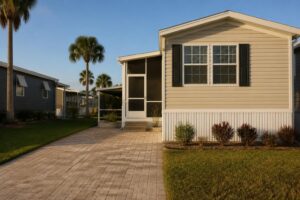
When a storm pushes across Bradenton or Sarasota and a manufactured home takes damage, the most important line on the policy is often the one owners read last: whether the home is insured on a replacement cost basis or an actual cash value basis. Understanding mobile home insurance replacement cost vs actual cash value florida coverage is one of the clearest ways to predict how a claim will actually pay out, long before you ever have to file one.
At our agency, we often see Florida owners surprised at claim time to learn their older home was settled on an actual cash value basis, with depreciation subtracted from the check they expected. The encouraging part is that this is usually a coverage choice you can understand and discuss in advance. Below, we walk through what each valuation method means, why the gap between them tends to be wider for mobile and manufactured homes, and the questions worth raising with your agent before hurricane season arrives.
What Replacement Cost and Actual Cash Value Actually Mean
The two terms describe how an insurer calculates what your home is worth when it pays a covered claim. They are not about how much coverage you carry; they are about how that coverage is measured.
- Replacement cost value (RCV) is generally the cost to repair or rebuild your home with materials of like kind and quality at today’s prices, typically without subtracting for age or wear, up to your policy limits. Many replacement cost policies pay an initial amount and then release the rest once repairs are actually completed.
- Actual cash value (ACV) usually starts from that same replacement cost figure and then subtracts depreciation for age, condition, and normal wear. The older a home or a component such as a roof, the larger that deduction tends to be.
The exact mechanics vary by carrier and by the specific policy form, so two policies that both say “replacement cost” may not behave identically. That is one reason we encourage owners to read the valuation language rather than assume. You can compare your options on our mobile home insurance page and then talk through the wording that applies to your home.
Why Replacement Cost vs Actual Cash Value Matters More for Mobile Homes in Florida

Manufactured homes can depreciate differently than site-built houses, and many Florida communities are full of homes built in earlier decades. Across parks in Sarasota and Bradenton, it is common to see units from the 1970s through the 1990s still in service. When an older home is insured on an actual cash value basis, the depreciation subtracted at claim time can be significant, which can leave a noticeable gap between the repair estimate and the amount the policy pays.
Florida’s wind exposure raises the stakes further. Manufactured homes are more vulnerable to wind uplift and partial losses than many site-built structures, so the odds of filing a wind claim over the life of the policy are real. When a partial or total loss is more likely, the difference between an RCV settlement and an ACV settlement stops being theoretical. The valuation method you chose years ago can shape how much you pay out of pocket to put the home back together.
How Depreciation Affects an Actual Cash Value Claim
Under an actual cash value approach, an adjuster typically estimates the cost to repair or replace the damaged portion, then applies a depreciation factor based on the item’s age and expected useful life. A roof, siding, flooring, and major systems each tend to depreciate on their own schedule. The result is a payment that reflects the item’s worn condition at the time of loss rather than the cost of a brand-new equivalent.
Replacement cost policies often work through what is sometimes called recoverable depreciation. The insurer may first pay the depreciated (ACV) amount and hold back the difference until you complete the repair and submit documentation. Once the work is done, the held-back depreciation can be released up to the policy limit. With a true actual cash value policy, that held-back amount is generally not recoverable at all. Because these details differ between carriers, it is worth confirming exactly how your policy treats depreciation before you assume a claim will be made whole.
Reading Your Mobile Home Declarations Page

Your declarations page is the short summary at the front of the policy, and it usually tells you which valuation method applies. When reviewing it, we suggest looking for a few things:
- Language such as “Replacement Cost,” “RC,” or “Actual Cash Value” near the dwelling coverage, sometimes abbreviated as Coverage A.
- A separate roof settlement schedule or endorsement, which has become more common on Florida property policies and may settle the roof on an age-based or ACV basis even when the rest of the home is on replacement cost.
- Any wind or hurricane settlement notes, since some homes carry different terms for storm-related losses.
If the wording is hard to interpret, that is normal. The terms are technical, and they are exactly the kind of thing we are glad to translate. You can also review how coverage is structured on a manufactured home insurance policy and bring questions specific to your declarations page.
Choosing Between RCV and ACV for Your Situation
There is no single right answer, because the better choice depends on your home, your budget, and any lender requirements. Replacement cost coverage typically carries a higher premium but can produce a stronger claim outcome, which many owners value in a storm-prone region. Actual cash value coverage usually costs less up front, which can matter for older homes where full replacement cost coverage may be harder to obtain or simply more than the owner wants to spend.
Older manufactured homes sometimes face insurability limits as well. Depending on the carrier, age, condition, and inspection results, replacement cost coverage may or may not be available, and an actual cash value policy may be the practical option. The point is not to push one method over the other, but to make the choice on purpose rather than by default. We are happy to lay out the trade-offs for your specific home so the decision reflects how you would actually want a claim to be paid.
Frequently Asked Questions
Is replacement cost coverage available for older mobile homes in Florida?
Sometimes, but it depends on the carrier, the home’s age and condition, and the results of any required inspection. Some insurers offer replacement cost coverage on older homes that are well maintained, while others limit those homes to actual cash value. We can check which options are realistic for your home.
Does actual cash value mean a smaller claim payment?
Generally an ACV settlement will be lower than an RCV settlement on the same loss, because depreciation is subtracted. How much lower depends on the age and condition of what was damaged. For a newer home the gap can be modest, while for an older roof it can be substantial.
Can my roof be settled differently from the rest of my home?
Yes. Many Florida policies now include a roof settlement schedule that may pay the roof on an age-based or actual cash value basis even when the dwelling is otherwise on replacement cost. Check your declarations page or ask us to review the endorsement.
How do I find out which valuation method I have now?
Your declarations page usually states it, often near the dwelling or Coverage A limit. If you are not sure, send us the page and we will read the valuation language with you.
If you would like a clear, no-pressure explanation of how your current policy would pay a claim, we are glad to help. Reach out through our request a quote page and we will walk through replacement cost and actual cash value options side by side, so you can choose the approach that fits your home and your budget.